Operational ticket systems usually fail at the control points.
A queue holds work but hides risk. A report counts tickets but misses service commitments. An integration creates tickets through an access path built for a person, not a system. An escalation rule exists in configuration but never governs the queue.
Recent Latch work focused on those control points: SLA governance, queue risk, programmatic access, status filtering, and escalation.
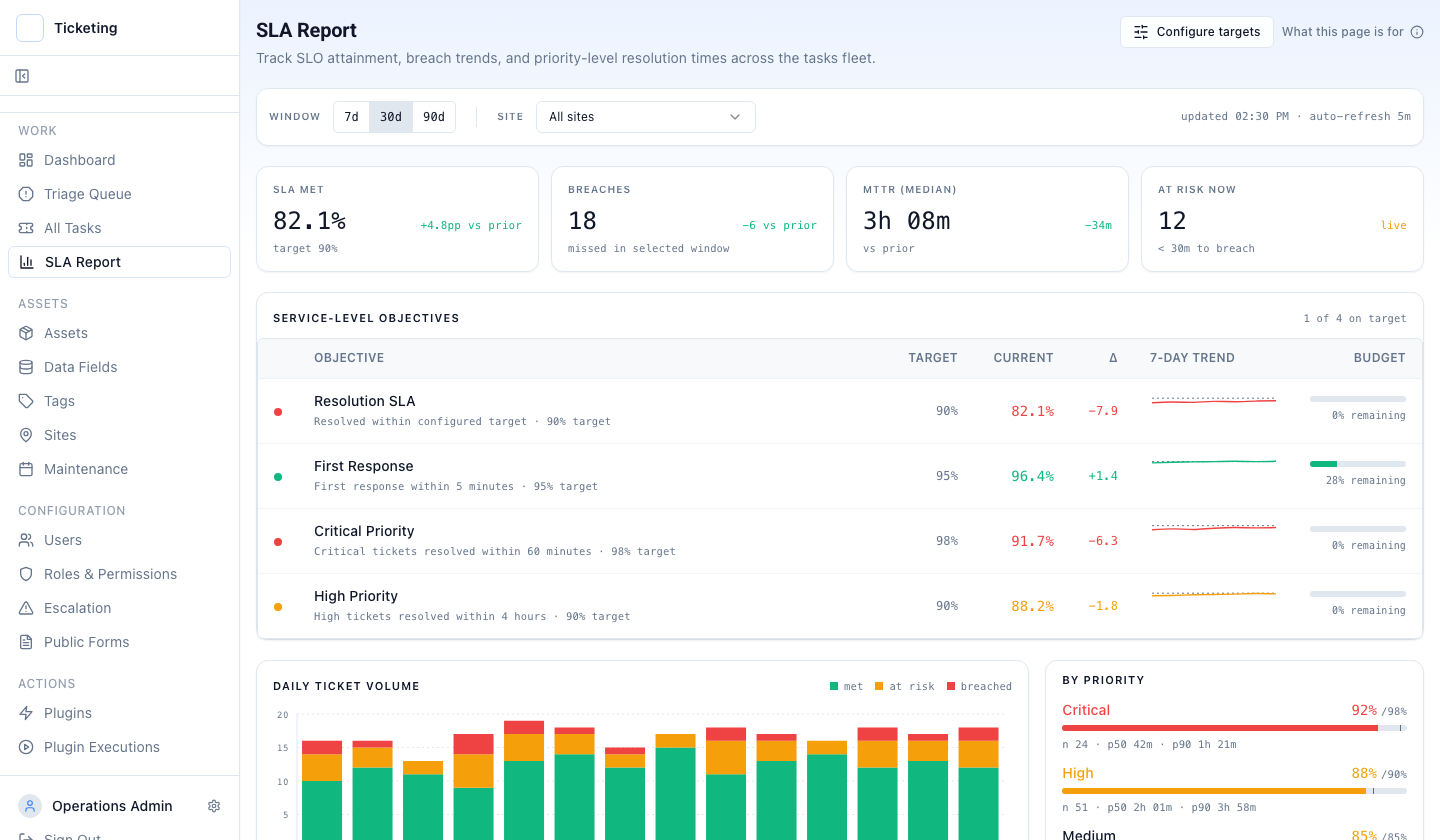
The SLA report keeps targets, breach visibility, service-level objectives, and priority performance in one operational view.
SLA Governance Starts With Configurable Targets
SLA reporting matters when the targets match the work.
Latch now supports admin-configurable SLA targets. Teams set expectations per queue instead of forcing one global target. A payment exception, a field service issue, and a low-risk support request need different response and resolution standards.
The value is governance. Managers review performance against targets they own. Operators see queue risk. Auditors separate normal load from missed commitments.
SLA Breaches Are Visible in the Queue
SLA reporting is retrospective. Queue visibility is immediate.
SLA-breached tickets get a clear list-level treatment and a breached label in the ticket list. Managers do not need to open every ticket or run a report. The queue shows what has crossed the line.
API Keys Separate System Access From Human Credentials
Customer environments need a clean way for systems to create and update work.
Programmatic access uses customer-specific API keys. Integrations that create tickets or update records should not depend on browser-auth workarounds. They need an auth path that belongs to the customer environment. It records usage and sits apart from human login.
A payment processor, monitoring system, field service tool, or source system can create work through a machine-to-machine path. The record lands in the same system. The credential is scoped to the integration.
Status Filtering Keeps the Queue Legible for Triage
Queues need filtering that matches how teams triage.
Ticket status filtering now narrows lists by state: new, assigned, in-progress, resolved, or exception. Operators find the work in the right state. They act and move on. Teams separate categories without manual scanning.
Escalation Rules Keep the Control Path Intact
Queues need escalation behaviour admins can trust.
When a rule says work should escalate, the system must preserve that control path. That matters for SLA-bound queues, high-priority tickets, and work that needs manager attention.
If an admin defines the rule, the queue can use it.
The Case Record Now Tells a Clearer Control Story
These changes share one principle: the case record should show the move, the reason, and the control applied.
SLA targets define the commitment. Breach visibility shows risk. API keys identify system-originated work without borrowing a human identity. Status filtering makes the queue legible. Escalation rules preserve the path for work that needs attention.
This is not surface polish. It changes how teams supervise work in flight and explain the record afterward.
The Direction Is Clearer Controls at Decision Points
The common thread is not one feature.
It is a move from generic ticketing toward controlled operational handling. Queues show risk and ownership. SLA configuration matches real commitments. API access fits customer boundaries instead of borrowing a human login. Escalation belongs to the queue, not outside it.
That is the shape of the recent work: fewer hidden states, clearer controls, and better evidence at decision points.
Where Latch Fits
Latch is for operations teams that need more than a shared inbox and more control than a generic ticket queue.
Teams handling SLA-bound work, system-created tickets, approvals, escalations, or high-risk exceptions need context preserved from intake to resolution. Recent Latch work moved those pieces into the surfaces operators use: the ticket list, SLA settings, ticket filters, governed API access, and the audit trail.
The goal: make the work easier to run and the record easier to trust.